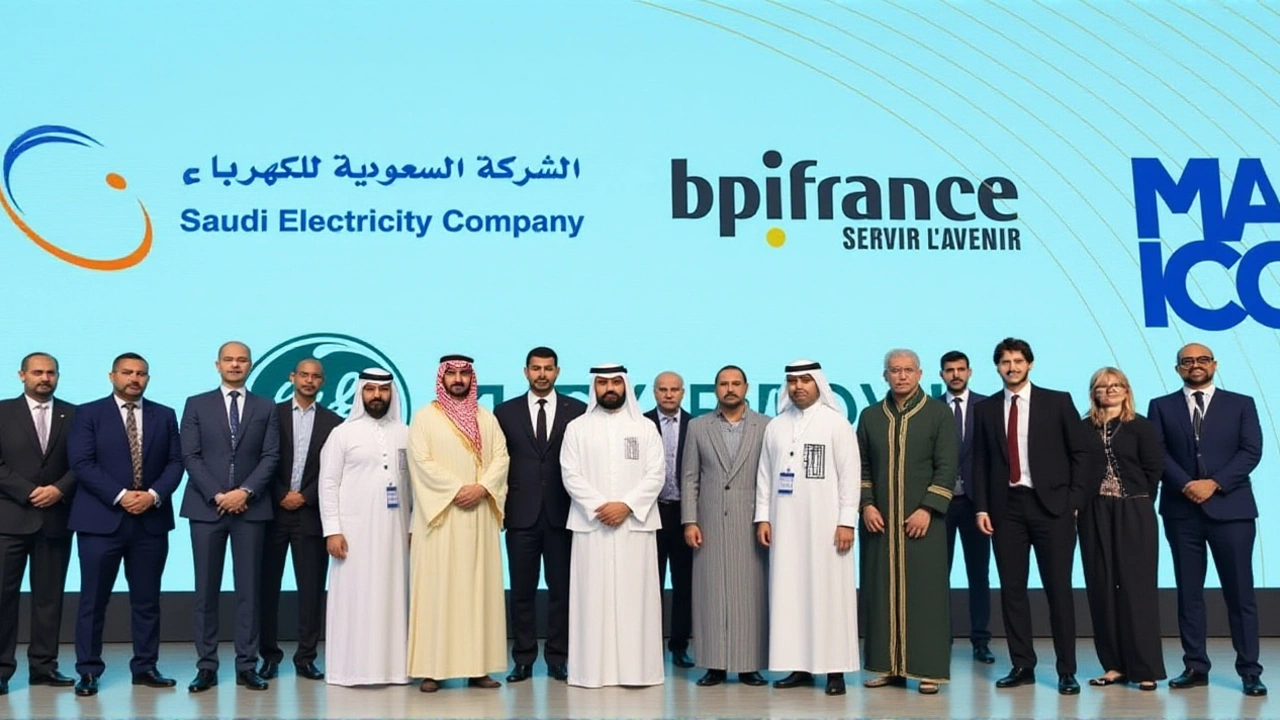
On November 26, 2025, under the glittering lights of Riyadh’s Future Investment Initiative (FII9), the Saudi Electricity Company, Bpifrance, and GE Vernova signed a $3 billion Memorandum of Understanding that could reshape how Saudi Arabia generates and distributes electricity. The deal isn’t just about money—it’s about reliability. As the Kingdom ramps up solar and wind power, its grid needs smarter, more flexible tools to handle the swings in supply. Enter heavy-duty gas turbines from Greenville, South Carolina, synchronous condensers, and maintenance networks built to keep the lights on—even when the sun isn’t shining.
Why This Matters for Saudi Arabia’s Grid
Saudi Arabia’s energy system is at a crossroads. The country aims for net zero by 2060, and renewable capacity is exploding. The Gulf Cooperation Council Interconnection Authority (GCCIA) expects renewable energy across the region to hit 120 gigawatts by 2030 and 180 GW by 2040. But renewables are intermittent. Solar panels shut down at night. Wind turbines go still on calm days. Without backup, the grid risks blackouts. That’s where the $3 billion MoU comes in. The agreement focuses on technologies that don’t just generate power—they stabilize it. Synchronous condensers, for example, act like shock absorbers for the grid, supplying reactive power to maintain voltage levels. These aren’t new ideas, but their scale in Saudi Arabia is unprecedented."This isn’t about replacing renewables," said one energy engineer familiar with the project. "It’s about making them work at scale. You can’t run a modern economy on solar alone. You need flexible, fast-response assets—and these turbines deliver that."
The Players and Their Roles
The Saudi Electricity Company, the nation’s largest power utility, is the anchor. Its CEO, Eng. Khalid Alghamdi, signed on behalf of SEC, which operates 90% of Saudi Arabia’s power infrastructure. Bpifrance, France’s public investment bank, brings deep experience financing large-scale infrastructure projects across Europe and Africa. Its involvement signals European confidence in Saudi Arabia’s long-term energy strategy—and opens doors for French engineering firms to join future bids.GE Vernova, spun off from General Electric in 2024, is the tech engine. Its Greenville facility manufactures the advanced heavy-duty gas turbines that will form the backbone of the new projects. These aren’t your grandfather’s turbines—they’re designed to ramp up and down quickly, syncing with solar peaks and wind lulls. The MoU also includes balance-of-plant equipment, spare parts, and long-term service agreements, ensuring the tech stays operational for decades. GE Vernova separately pledged up to $14.2 billion in total energy initiatives for Saudi Arabia, with $2 billion already in backlog as of Q1 2025.
Bigger Picture: $575 Billion in US-Saudi Deals
This $3 billion deal is one thread in a much larger tapestry. It’s part of the $575 billion investment pact between the U.S. and Saudi Arabia, forged during President Donald J. Trump’s May 2025 visit and expanded at the US-Saudi Investment Forum in Washington DC. Within that, the Energy & Petrochemicals sector accounts for $143.6 billion across 83 deals. Aramco, ACWA Power, and SEC are partnering with ExxonMobil, Baker Hughes, and SLB on LNG, carbon capture, and hydrogen projects. The SEC’s MoU with Bpifrance and GE Vernova is the first major agreement specifically targeting grid resilience as a standalone priority.Adding to the momentum, SEC also signed a $1 billion Export Credit Agency (ECA) framework with Swiss Export Risk Insurance (SERV) and Standard Chartered Bank at FII9. This structure reduces financial risk for international suppliers, making it easier for them to commit capital to long-term projects in the Kingdom. It’s a quiet but powerful innovation—turning political will into bankable contracts.
Regional Ripple Effects
The impact won’t stop at Saudi borders. The GCCIA’s expanded interconnection with Kuwait, completed in Q3 2025 at a cost of $260 million, now allows surplus power to flow across borders. As Saudi Arabia’s renewable capacity grows, it can export excess electricity to neighboring nations. Meanwhile, the Al-Wafra substation, now fully operational, acts as a regional hub. Analysts say this could turn Saudi Arabia into the "Germany of the Gulf"—a stable, flexible power supplier for the entire region."We’re not just building power plants," said Saudi Minister of Investment Khalid Al-Falih at FII9. "We’re building energy sovereignty. And that means partnerships—not just with corporations, but with nations that share our vision."
What’s Next?
The first projects under the MoU are expected to break ground by mid-2026, with initial turbine deliveries scheduled for late 2027. By 2030, the new grid-stabilizing assets could support up to 15 GW of additional renewable capacity. SEC has already begun retrofitting older plants in Jubail and Yanbu with digital control systems that integrate with GE Vernova’s predictive maintenance platforms. That’s the real game-changer: not just adding new equipment, but making the entire system smarter.Still, challenges remain. Supply chain delays, labor shortages in specialized engineering roles, and regulatory hurdles for foreign-owned tech could slow progress. The Kingdom is betting heavily on its ability to attract and retain global talent—and so far, the signs are promising. With over 400 international companies now operating in NEOM’s energy zones, the ecosystem is growing.
Frequently Asked Questions
How will this MoU help Saudi Arabia meet its 2060 net zero target?
The $3 billion agreement directly supports grid stability as Saudi Arabia integrates more solar and wind power. Without flexible backup like GE Vernova’s gas turbines and synchronous condensers, renewables can’t scale safely. These technologies allow the grid to absorb fluctuations without blackouts, enabling Saudi Arabia to phase out coal and gas peakers faster. Experts estimate the MoU could reduce carbon emissions from power generation by 12 million tons annually by 2035.
Why is Bpifrance involved in a Saudi energy deal?
Bpifrance is France’s public investment bank, and it has a mandate to support international infrastructure projects that align with climate goals. Its participation signals European alignment with Saudi Vision 2030 and opens pathways for French firms like EDF and Schneider Electric to join future bids. It also helps de-risk financing for Saudi projects, making them more attractive to private investors in Europe and beyond.
What’s the role of GE Vernova’s turbines from Greenville, South Carolina?
These turbines are among the most flexible in the world—capable of ramping from idle to full power in under 15 minutes. That’s critical as Saudi Arabia adds more solar, which shuts down at sunset. The turbines act as a rapid-response backup, preventing blackouts. Built with a deep U.S. supply chain, they also reduce reliance on single-source components, improving long-term reliability. GE Vernova has already delivered similar units to Egypt and Morocco, proving their adaptability to hot, arid climates.
How does this affect everyday Saudis?
For consumers, it means fewer blackouts during summer heatwaves, when demand spikes and solar output drops. It also lowers long-term electricity costs by reducing the need for expensive, inefficient peaker plants. More importantly, it supports job creation—over 8,000 local jobs are expected to be created in operations, maintenance, and technical training by 2030. This isn’t just about energy—it’s about economic resilience.
Is this part of a larger U.S.-Saudi energy strategy?
Absolutely. This MoU is one of 83 deals under the $143.6 billion Energy & Petrochemicals pillar of the $575 billion U.S.-Saudi pact. It complements Aramco’s LNG projects, Baker Hughes’ carbon capture work, and SLB’s digital oilfield initiatives. Together, they form a comprehensive strategy: secure energy supply, decarbonize industry, and position Saudi Arabia as a global energy technology hub—not just an oil exporter.
What happens if the U.S. changes its energy policy after the 2028 election?
The MoU is structured as a long-term partnership, not a government-to-government deal. GE Vernova operates as a private company with global supply chains. Even if U.S. policy shifts, the turbines are already manufactured under existing contracts, and the service agreements are locked in for 10–15 years. Plus, Saudi Arabia has diversified its partnerships with French and Swiss entities, reducing dependency on any single nation’s political winds.